
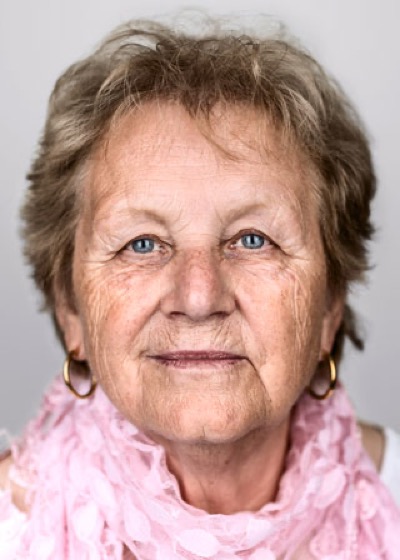
I came into the world on 31 December 1938 in Burgdorf. My mother was a housewife; my father worked as a paver and was employed by the town of Burgdorf. Unfortunately this work, which was certainly very hard, was not good for his health – he was very often ill in hospital – so that on 28 February 1943 he died at the Inselspital in Berne at the age of 34. I was the second eldest of 4 children: my brother was born in 1937, I in 1938, and my sisters Käthi in 1940 and Doris in 1941. We were all assigned a guardian. According to the files, my father's illness had meant that we had been supported by welfare for some time already.
Read more
Although it was not our fault, this was already the first stigma stamped on our lives. Our mother soon remarried, and in May 1944 our first half-sister was born; three more children followed.
Our stepfather could not cope with us children from the first marriage. He did not like us either, and so he demanded from the guardianship authority that we four be placed elsewhere. This was duly carried out the same year. For me the date was 12 October 1944. Because we 4 children were farmed out to different places, we saw each other at most 2–3 times during our entire schooling. I did not see my youngest sister until I was 68. She did not even know she had 3 siblings – and that they, just like her, had also been placed as contract children.
I was the youngest of a total of 14 contract children placed at this foster home over the years. These smallholders in the Emmental village of Gohl had no children of their own, and without the many contract children the work on the steep slopes would simply have been impossible. We replaced the farmhands and maidservants who were needed, and we had to work genuinely hard. The farming family also received board money from the guardianship authorities – 360 francs a year for me. An important form of subsidy at the time. There was no running water in the kitchen of that farm and no electricity in the house. For the slightest transgression we received a slap on the face from the foster mother, or we had to pull our trousers down in the barn and the carpet beater was applied to our bare backsides. We also had to sleep two to a normal-width bed. I was a bedwetter until year 5, as were all my siblings. The room was unheated, with ice flowers on the windows in winter. Food was simple, but at least there was enough. For homework there was only time on Sundays.
From Monday to Saturday it was hard work. Before school, feeding and mucking out the hens and pigs. Then to school unwashed and smelling, teased and bullied by some classmates because of it. Only one teacher was impartial. Since we could not bring sausages and other treats, the farm children were favoured. We had to wear hand-me-downs from the older ones; only for the school examination was there anything new, chosen large enough to also fit at the next examination. The guardian who wrote the reports about me every two years I never saw myself. A Mr Stucker did come by every few years. I had to show my school report and open the wardrobe. He received a good afternoon snack. The biennial file note always contained the same wording: she is a well-behaved child, is encouraged to work, the foster parents fulfil the duty assigned to them, her school report can be rated up to good but could be better. Since I was too small and slight and had a steep and long walk to school, I was nearly 8 before I could start school and did not finish compulsory schooling until I was sixteen and a half.
I wanted to become a hairdresser, but would have had to move from Gohl to Waldstatt in Appenzell, where my mother and stepfather had lived with their family for years, and travel daily from there to St Gallen for my apprenticeship. We had been farmed out as young children. Now, as near-adults, I was supposed to go back – who could be expected to understand that? The main thing, once again, was that I remained taken care of from the responsible parties' point of view and their problem was solved. We all have a very good relationship with our stepsiblings. The only alternative was the one-year domestic training year for 15 francs a month's wages. That meant toiling from six in the morning until seven in the evening, or longer, at a vicar's house. His wife was partly employed outside the home and was tight-fisted; he, however, was kind. They had young children, and I enjoyed looking after them; I was used to working, and I liked it there. Afterwards I spent another year in domestic service at a doctor's house in the same place, and later in an office as an auxiliary. The topic of a formal apprenticeship was definitively off the table, and I had to get by on my own without any help whatsoever.
At the age of 19 I became pregnant. Immediately the guardianship authority stepped in again. I was pressured to give up the child, as it would only be a burden for a 19-year-old girl. There were so many adoptive parents who wanted a child, and the child would then have a secure future – surely better than with me, since I didn't earn enough anyway. But I resisted with every ounce of strength I had. I now know women who did not have that same strength to resist, and who had to suffer for it their whole lives because they did not know where their child had gone. Coercing underage, unmarried girls was common practice and cost the authorities far less. At the time it was still a disgrace to have an illegitimate child as an unmarried mother. During a visit to Langnau I ran into my former boyfriend again and we fell in love. We married and are still happily together today. Our four children are grown up and have given us eight grandchildren and two great-grandchildren. We have a beautiful, loving relationship and are often all together. We live in our own home that we worked hard for ourselves. But the stolen childhood remains present in my memory for the rest of my life.
We take your experiences seriously - confidential and personal. Or support our work as a member.
This website uses only technically necessary cookies. More information in the Privacy policy.