
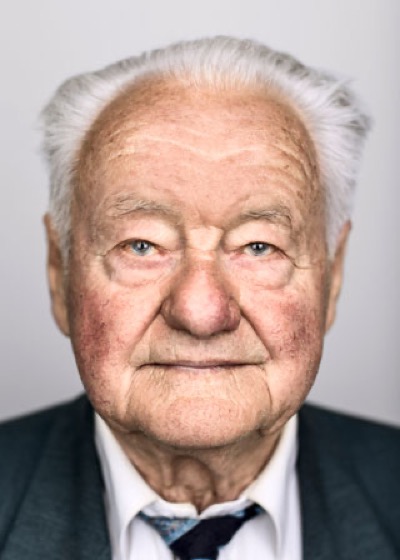
As a toddler, barely a year old, Jean was taken to foster parents and a few years later placed as an indentured child with a farmer. He did not see his biological mother again until he was 11, and returning to her and her family was not possible. Despite time in a reformatory, he managed to prove himself through his apprenticeship and in life.
Read more
Charles Probst: Why did I become a contract child?
What was hidden from me as a child
It was only as an adult, around 1950, that I began asking questions about my origins and my parents' earlier lives. I could find out nothing about the childhood of my supposed father. My relationship with him was cold, and I did not dare to do many things my brothers were permitted to do. He repeatedly remarked to my brothers that I was not his son. This made me alert, and I began to question my mother. She then confessed that from 1926 she had been placed as a maidservant on a farm in Heimiswil. There, the farmer of the time fathered me. When the matter became known, she was dismissed – she was, after all, only a maidservant. My biological father evaded his responsibility and never paid any maintenance. Fortunately, my mother soon found work as an office girl at the Hotel Bristol in Bern, where she met my stepfather, who then presented himself as my father. Professionally he worked as a miner in tunnel and power-station construction. He was then required for health reasons to undergo a rest cure. The Salvation Army presumably supported him financially at that time. He, however, broke off the cure early and returned to his family. He was now unemployed, and unemployment benefits did not yet exist. The entire family was therefore destitute. My mother had to manage the household alone. Only the family doctor knew of the precarious situation. He therefore arranged for the boys to be sent for cures and placed under tuberculosis supervision. As the eldest, I was under guardianship and placed as an indentured child. When my stepfather became unemployed, the guardianship authority even applied to place him under guardianship, dissolve the household and put the children elsewhere. Fortunately, the stepfather was able to prevent this; he knew his rights and stood his ground. Already during my mother's last pregnancy the guardianship authority had pressured her to undergo sterilisation. She resisted, but eventually agreed to the procedure in 1935. During the Second World War, the father was on military service. My mother had to manage alone with the two children. This was no easy matter given food rationing and meagre women's wages. Compensation for military service earnings did not yet exist either. The Winkelried Foundation for such hardship cases did exist at the time, but those who truly needed it knew nothing about it and were not informed, even though the company commanders were aware of it. Out of necessity, my mother had to place another boy in foster care. Even if there was now one less mouth to feed at the table, poverty remained a constant companion. The youngest was confirmed in 1949. Because there was no money for new shoes for the occasion, I, as the eldest, had to swap shoes with my brother. I had bought those shoes in Fribourg with my apprenticeship tips. Despite hard work there was always a shortage of the most basic necessities. By today's standards, my parents belonged to the working poor. Pasta, bread, and black coffee without milk were the staples of our diet; anything more was a rare luxury. When a cousin came to visit, my mother had to borrow money from the neighbours just to buy milk. Our home at the time was a dilapidated wreck. The authorities knew of this but did nothing to improve the family's situation. There was no running water in the kitchen, and the outhouse was far from the building. The living-room floor of rough fir planks was treacherous – the cleaning rag would constantly catch on it when I swept. My parents had a hard life. My mother suffered additionally: the stepfather beat her too. Even with a family she continued to live miserably. Yet mother and stepfather stayed together until the end of their lives. I later discovered that my mother had also been placed as an indentured child when young, had been unable to learn a trade, and had remained a maidservant – even though she had all the prerequisites for a commercial apprenticeship.
Start with a Handicap
I was born in 1930 in Bern as the illegitimate child of Fritz Pilcher. Shortly after birth I contracted pneumonia. Once I had recovered, I was placed in the infant home in the Elfenau. It was only some months after my birth that my mother married the man said to be my father. On 13 February 1931, the District Prefect's Office formally removed their parental authority because they had not yet established a joint household and the authorities considered the childcare inadequate. The guardianship placed me, barely a year old, with foster parents in Lyssach. In December 1931 my mother and stepfather abducted me back to Bern. However, the authorities immediately retrieved me and returned me to the foster family. From that point on, my mother and stepfather abandoned all contact. My foster parents had leased a small farm, which they ran with their four daughters. In spring 1935 they bought a larger farm of their own in Aefligen. I felt well cared for in this family. I still had no idea what a contract child was, nor that I was one myself.
Placed as a Contract Child and Ostracised
When I was about ten years old, I had an argument with the daughters while washing up. I threatened to report them to the mother, but the girls replied: "You don't have a mother at all!" The farmer's wife then scolded her daughters for having let the secret slip.
A Lucky Escape
I screamed and wept and ran out into the farmyard, straight into a tree. I screamed even louder, could no longer make sense of the world, and wanted to disappear. I then ran back to the house and took the rifle that was kept behind the front door. I wanted to end my life. But the rifle was bigger than I was. I tried to put the barrel in my mouth and pull the trigger. The scene is still vivid in my mind today. Fortunately I was too small and my arms too short. I thought I could pull the trigger first and then reach the barrel end. The shot went off; the bullet grazed the ring finger of my right hand and lodged in the ceiling. I was paralysed by the bang. The foster mother rushed over, took the rifle, and put it back in its place. I never touched it again. But it was a long time before I could process what had happened. From then on I often hid in the outbuildings of the farmhouse, because I sought protection and the building gave it to me. When called, I would keep completely still in my hiding place. The daughters would then search for me in vain. When they could not find me, they claimed I was wandering around the village. In truth I had never intended to do so – I was too afraid of being beaten up in the village.
A Brush with Death
At Christmas I always received a pair of wooden clogs, some socks, and an apple. To make the clogs last longer, the foster father had the village blacksmith fit an iron hoop around them. This meant they could always hear where I was. And that saved my life. I was 8 years old. In the morning I was at school; at lunchtime we sat at the table in the living room. After the meal the two daughters cleared up. The foster father and foster mother stayed at the table. The foster parents were occupied with the post and reading the newspaper. I said I needed to go to the toilet. The foster mother said: "All right, go – but I'll undo the back of your trousers. And mind the flap when you're in there." I ran out of the living room, through the kitchen, through the hallway, across the stone-cobbled floor heading for the outhouse. But I never got that far. After the cobblestones there would have been a wooden floor and then some concrete. But after the cobblestones it went quiet and Jean had vanished from sight. The foster father heard this and realised that the slurry pit was open. He had been spreading slurry that morning and had not covered the pit. He ran to the open slurry pit and looked down. He saw three small points sticking out of the slurry. He reached in, grabbed my hand, and pulled me out. The foster mother and daughters were called and had to fetch water from the well in front of the house. My clothes were removed and the water poured over me. Once I was clean, they wrapped me in cloths, carried me into the living room, and sat me on the stove. The whole afternoon the mood was sombre. They knew perfectly well that the foster father had negligently left the slurry pit open. There is nothing in the files about this incident, even though the Steffen neighbours had witnessed everything.
Put to Work Early
I had to pitch in vigorously with all the work on the fields and in the barn. Fortunately I soon became familiar with the animals, and I had a particular fondness for the horse, which I was allowed to guide and lead. The horse was kind to me. It was a magnificent grey. This was why the village called my foster family "Schümelipuur" and I was called "Schümeli-Verdingbub."
Emotional Distress
Like most indentured children, I was a bedwetter. Because the bed linen dried poorly in winter, I had to sleep in the barn in the straw. But I had a faithful companion in the farm dog. At the new location in Aefligen, I was particularly bullied by the cheesemaker and his two sons. These sons would lie in wait for me on the way home from school to beat me up. However, there were some families in the village who stood by me and where I was welcome. Visits from the authorities were rare. The welfare officer, Miss Küry, appeared twice a year; she was well-disposed towards me and I remember her fondly.
Consequences of Vaccination
During my school years, the compulsory smallpox vaccination caused a severe skin rash that banished me to the Jenner children's hospital in Bern for several weeks. After my recovery I was not allowed to return to my previous foster family. During my illness-related absence, my guardian had already placed another boy with the farmer. I was passed on to a different foster placement, but difficulties arose there within a short time. Even as a fourth-grader I was exploited as a labour force, regularly beaten and punished.
Flight, Punishment, and Harassment
I ran away, was picked up by the police the following day, and was committed by my guardian to a labour institution for difficult-to-educate boys. I remained there until the end of my schooling in spring 1946. The director, called the "Heimvater," was a tyrant. There were constant painful blows with a willow switch on the hands or the seat of the trousers. Because I was an average pupil I was rarely punished in that way. But I was bullied and humiliated again and again because of my bedwetting. Boys who wet their beds had to stand against the wall in the dining room in the morning while their peers ate breakfast in front of them. Afterwards they received only dry oats and nothing to drink for the rest of the day. I managed by quenching my thirst with water from the toilet bowl. Late in the evening bedwetters were woken again and sent to the toilet. On one such occasion the duty supervisor discovered that I had had sexual contact with another boy, because he found us both sleeping in the same bed. The older, stronger boy had led me into it. I had allowed the sexual abuse to happen because that fellow inmate always protected and defended me in quarrels.
How I Found My "Parents"
It was not until I was eleven that I met my mother and stepfather one Sunday. I walked past them twice around the house first. On the third pass my mother called out: "You must be Jean!" "No, I'm Hans!" I replied. I had not been called by my baptismal name until then, even though it was correctly recorded in the documents and school report. My mother had had three more boys with my stepfather. Two lived at home; the third was placed away from home, as I was. After this encounter I maintained contact with my relatives, but a real relationship never developed: "The half-brothers were privileged, while I was ridden roughshod over."
How I Held My Own in the Labour Institution
A strict order prevailed, and we boys were given various tasks. In year 8 I was assigned to the mowing group. I was the smallest and weakest. But gradually I too grew stronger. Before long I was also called upon to mow grain. "There, one counted for something, and I managed to find my place and get back on my feet."
An Apprenticeship by a Roundabout Route
After my schooling I would have liked to begin a mechanic's apprenticeship. Despite passing the aptitude test, my wish was not granted on financial grounds. So I went to a farming family again, this time as a farmhand. "I was advised to consider a different trade. In 1947 I took up an apprenticeship as a gardener in the Seeland. Board and lodging were included at the training firm. Work was expected on Sundays too in those days. After two years, sexual assaults occurred here as well, perpetrated by the master's son. When I was 18 I took the second son's motorbike without permission. The nocturnal joyride ended at a tree, due to the rough road and my lack of riding experience. I was injured and the motorbike badly damaged. I was scolded and locked in my room on the first floor. I escaped from there and went to my 'parents' in the Emmental. I looked for work in the area myself and found it on a construction site. Once I had saved the money for the motorbike repair (250 francs), I returned to my former master and paid for the damage. The master wanted to keep me, but after the sexual assaults by his son I could not stay with him any longer. My guardian found another apprenticeship in Villars-sur-Marly. I liked it there, and the master was also satisfied with me. The only problem was that the promised wages never materialised. In return I received enough tips from customers. And I even passed the final apprenticeship examination with a good result. Afterwards I worked in a seasonal position near my parents. In July 1950 I was supposed to enter the recruits' school. I postponed this in order to finally escape from the guardianship."
End of Guardianship and Flight to France
"When I applied for discharge from the guardianship I also asked for my savings book. Both requests were granted, but the account was empty. I set off towards Paris by bicycle and tent. When I returned to Switzerland in 1952, unemployment was widespread and finding a position in a nursery garden was almost hopeless. I therefore took on all manner of jobs in order to support myself."
Further Education and Self-Employment
"Because I was able to work in garages, I also became a driving instructor. Lacking money, I accepted a van as payment from a pupil and began making my way in this
industry. The timing was favourable, and I threw myself into it properly. Fairly quickly I built up a suitable fleet of vehicles so that I could also work in the international transport business. Before long I even secured contracts for the Orient. But it was not only the trucks that suffered – so did the family. In 1983 I left our shared flat and my wife. In 1987 we divorced. This is my life, with its highs and lows. Since giving up the transport business I have been a pensioner and hope for a few more good years."
Text revision: Walter Zwahlen
We take your experiences seriously - confidential and personal. Or support our work as a member.
This website uses only technically necessary cookies. More information in the Privacy policy.