
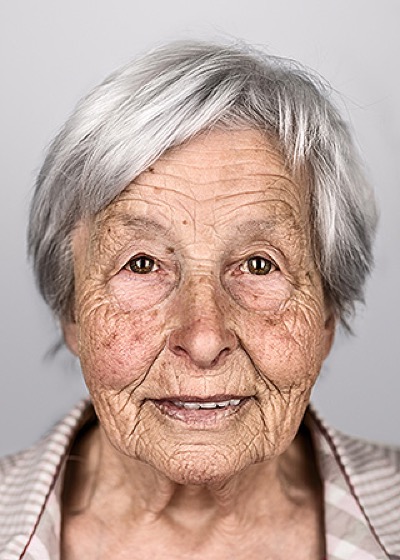
I was born in 1933 in Lützelflüh (BE), the second eldest of what became four children. I was able to stay with my mother for the first year. In 1937 my father died of blood poisoning. Three of us siblings were placed as indentured children with farmers at different locations. First, following the authorities' orders, my mother took my two brothers to the corresponding foster families in Mungnau (BE). The following day she packed my few belongings into a small cardboard box. We set off together. On the way she suddenly said she had forgotten something. I was to wait at the inn while she fetched it…
Read more
After a while she returned, but without anything further. I later understood that she had wanted to delay a farewell that was hard for her.
I was placed with the Röthlisberger farming family in Bomatt near Zollbrück (BE). The village was part of the large municipality of Lauperswil, which had many small farms with many contract children. The Röthlisbergers' son was already serving a butcher's apprenticeship at the time, so I grew up there like an only child. I always missed my mother and my three brothers and felt very lonely. Only our youngest brother was able to stay with our mother, who worked as a maidservant or housekeeper for various farmers. I myself had to work hard from a very young age. Because I was still so small, the beginning of every new task was difficult or worse. No one guided me, helped me, or considered that too much was being demanded of me.
I remember the farmer's wife as a truly wicked woman. She often beat me with the carpet beater. Sometimes a punishment of this kind was so brutal that for two days I could neither sit down nor go to school. During that time I could only eat standing up. No one supervised the conditions of my placement. In my class of about 30 pupils there were 14 contract children. One of my brothers was placed not far from me with another farmer and had it far worse than I did. His teacher was very partisan, which meant the socially weakest suffered most under his regime. I loved school and do not, looking back, see it as having been disadvantageous for me. Mental arithmetic was a struggle. If I could not see the numbers in front of me I was lost – something the teacher unfortunately never understood.
My mother could visit me at most once or twice a year, briefly, since she changed workplaces frequently and had little free time. She usually came by bicycle, sometimes from far away. She thought I was doing all right there, and only learned much later of all the suffering I had had to endure. The foster father was decent to me and never hit me. During the day, however, he worked in a factory, so I was at the mercy of the farmer's wife's arbitrary cruelty for most of the time. When he was at home, I sought his company by helping him with his work. He too suffered from his wife's malice. Even the son was not safe from her wickedness; he later took his own life. I tried to console myself at the time by telling myself that the farmer's wife could not love me because I was not her biological child. What sustained me in my distress was the certainty that when school was over I could leave this place. But the isolation, the loneliness, and the misery that came with it would catch up with me again and again. I always had an immense longing for my mother and my brothers. Once I even thought about suicide. During the years of the Second World War the farmer's wife would send me to the neighbours to exchange unwanted food ration cards. I very much enjoyed this bargaining and trading.
My actual wish had been to train as a children's nurse. But after school I went as a nanny to farmers above Morges (VD) for a year in French-speaking Switzerland. I did not learn French there, however, as these farmers were German-speaking Swiss. From there they sent me for six months to relatives above Montreux. Afterwards I found a position in a crèche and later in the kitchen and as a nursing assistant at the hospital in Langnau (BE). The head chef was from the Canton of Glarus and intended to return there to take over a restaurant of his own. Because his wife was expecting their second child, he asked whether I would like to come with them to help his wife in the household and look after the children. That is how I came here. I did not particularly enjoy working in the restaurant and was not often asked to.
In Glarus I then also met my future husband. We married in 1955. That same year our first son Ernst was born. Two years later came the second, Werner. With money from the compulsory inheritance share from the estate of my grandfather, my biological father's father, we were able to take over an electrical goods shop on 1 August 1959. Unfortunately my husband contracted poliomyelitis with meningitis in 1960. He suffered from frequent headaches as a result, and a residual muscle weakness remained. So I ran the shop, including the office and accounts, largely on my own. We were ultimately forced to give up the electrical goods business. Together with the mountain guide Frigg Hauser I founded a mountaineering school, which we later converted into an outdoor sports shop. I still run this today together with my daughter Anna-Elisabeth. On my travels to Bhutan and Nepal I encountered the poverty in those countries. I committed myself to improving the lives of the people there.
We take your experiences seriously - confidential and personal. Or support our work as a member.
This website uses only technically necessary cookies. More information in the Privacy policy.