
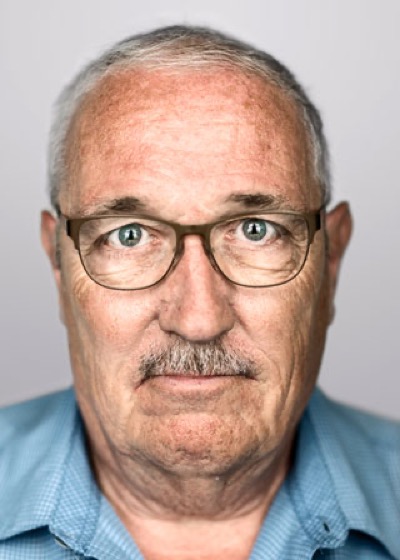
I was born on 3 November 1951 in Berne. The first year of my life in Berne passed almost normally, apart from a fracture of the nose in the playpen that went without medical attention. My father worked for the Berne city building department and was away all day. My mother apparently had little desire to look after me, so as soon as I could walk I would go "ring doorbells" in the house and invite myself to meals. I have a sister one and a half years younger than me. I no longer remember any experiences with her in Berne. In spring 1955 I left Berne to go to acquaintances from my father's youth (a foster family, but placed like all the others), smallholders in the municipality of Schwarzenburg…
Read more
My sister was taken in by an aunt – the father's sister – and directly adopted. During all my youth I had around 15 contacts with her.
Once a year the lady from the official guardianship office in Berne would come – she was the receptionist of my statutory guardian – to check whether the boy had a bed and enough to eat, and to review his school performance. The guardian himself could not attend to this – hardly surprising with close to a thousand wards!!! What he supervised pedantically and meticulously was the flow of money.
Now two or three key experiences from 1955 to 1967. So as not to alienate the other pupils, I was known in primary school as Kurt Müller – that is, under the foster family's surname. Then came the transition to secondary school and the then village registrar of the Wahler municipality – an extremely "correct" and devout man – decided that I must now either be adopted or bear my legal surname Gäggeler; I chose the latter, whereupon he told me in front of the foster parents that I had no right to decide, and I left the kitchen with the remark that I knew perfectly well where the Schwarzwasser bridge was. Unfortunately I have never been able to track down the official communication he sent to my guardian about this episode. In year 8, discussions began about what trade I would like to learn, or should learn. My wish was to become a cook; the guardian ordered commercial training instead. At least I was able to prevail in my choice of location among the various apprenticeship placements. A country bumpkin in the truest sense of the word, I now arrived in the big city of Berne – during my school years I had been there about three times, always with a companion. For me this freedom was almost too great, and things happened that would not have happened to so-called normal young people, not least because they naturally
knew far more about "life." I survived these relatively wild and eventful years essentially unscathed and entered recruits' school in Kloten with friends after the apprenticeship. As a November child I did not turn 20 – and thus come of age – until after recruits' school.
In 1966 my biological father died at 55 after a prolonged illness. Despite our few contacts it was a bitter loss. My guardian summoned me one last time; he handed me a savings book with a balance of CHF 8.70 and informed me, among other things, that I had a half-sister on my mother's side who wanted nothing to do with me. I took note of this and turned back to the life that brought me joy. I met my future wife and we married at 22 – the marriage has lasted until now, and I am proud of that, because I knew what it meant to be a child of divorce. A professional and family life then began, with the steady desire to improve myself and, as one says casually, to work my way up. Shaped by my youth, I was always open and direct, which was not always beneficial for my career. But I am satisfied on the whole, and have enjoyed looking in the mirror in the morning right up to the present.
When I was 60 years old I became increasingly interested in details about my origins and began searching – a gruelling undertaking with many "low blows" – for I had to come to terms with the fact that various people had treated me badly as a "contract boy"; a few examples are worth mentioning:
The "adoption scene" – the choice of career – the theft of money: my father had actually left me around 16,000 francs – the record of my entry into the commercial apprenticeship states that I am pale and frail, even though I had regularly been competing in wrestling and doing farm work – the lie that the half-sister wanted nothing to do with me was also exposed when my biological mother died – the whole thing is, in truth, an endless story, incomprehensible to outsiders; what society thinks of such events could be read and heard at the latest during the reparations initiative.
Despite everything, my resentment has become very small – instead, since retirement I have invested much of my energy in ensuring that this sorry history is finally dealt with properly, that a historical document is created about it – analogous to the "Berchier Report" – and, more importantly, that these acts of arbitrary authority and in some cases deliberate defamation are curbed. My family always got on well with my foster parents – the foster father died in 1995, the foster mother in 2015. They were truly good grandparents to our sons.
Conclusion:
The first three years were nevertheless very formative for my character, as was the ugly scene with the village registrar over the adoption; for many years the world for me was only black/white, or in other words good/evil – right/wrong. That did not make my life easier; it was only at around 60 that I became increasingly capable of "consensus." My greatest achievement has been and remains that my dear wife and I managed to keep the family together despite sometimes very heavy "burdens" – financial ones included.
We take your experiences seriously - confidential and personal. Or support our work as a member.
This website uses only technically necessary cookies. More information in the Privacy policy.