
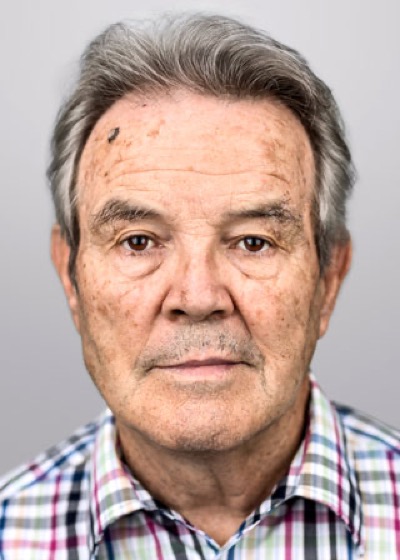
Hugo Zingg was born in 1936 in the Matte working-class district of Bern. His father was a mechanic. He spent his early childhood years, until shortly before starting school, in what was called a children's home in Kleindietwil in the Oberaargau. The owner, a hairdresser, looked after several children from elsewhere in exchange for a boarding fee. In the winter of 1942/43 Hugo was placed as an indentured child on a medium-sized farm in the Gürbetal. He was put to work on all tasks in the fields, the house, and the stable. He slept in the unheated, dark loft together with the young farmhand, who had himself previously been an indentured child.
Read more
The mattress in the shared bed consisted of a straw filling in coarse jute fabric. The farm's entire infrastructure was old but well maintained. In the living quarters there was a kitchen with an open chimney, the farmers' living and sleeping room, and two lofts above. Heating was by wood. I had to haul wood into the kitchen, light the fire, cook the pigs' swill, wash the dishes, clean the floors, beat the carpets. Help in the fields during grazing, feed the horses, cows, and pigs in the stable, muck out, and drive the milk to the dairy.
The walk to school took between half an hour and three-quarters of an hour in winter, depending on the snowfall. In summer I first had to bring the midday meal to the people working in the fields. Because of the long travel time and the short school lunch break there was often no time left for me to eat. The same procedure applied in winter when wood was being felled in the forest. Until my confirmation I never had new clothes or shoes. I had to wear old ones, usually in sizes too small for me. There was no underwear either – you simply tucked the shirt into the trousers. I find it deeply troubling that a child could be exploited continuously through seemingly endless work. In my eyes this is a crime. Any development of one's own personality was systematically suppressed. Only with the animals did I have a good connection. Instead of rights and opportunities for development, there were beatings and scolding.
Only on the walk to school were there moments when I enjoyed a degree of freedom. I went to school for the teachers' sake and because one had to – learning was secondary. I received my own skis from the teacher via Pro Juventute. For the farming couple this expenditure on a contract boy was pointless. In the upper school we got a young teacher who did a lot of sport with us. But the bicycle excursions were off-limits for me. Because of the farm work I missed countless school hours. None of these absences are recorded in my report. The teachers were always bribed at Christmas with generous gifts in kind. My entire childhood was the same unvarying treadmill in an unreal, sealed-off world with its own rules. And so at my confirmation dinner I was served the detested sauerkraut. The farming couple themselves went out to eat well.
The farmer's wife was fond of beating me with a leather strap several times a week. On top of that I was a bedwetter. Every unpleasant incident, every mishap was clearly my fault in her eyes and led to blows. From year 8 onwards the farmer's wife delegated the punishments to the farmer. He would simulate the procedure with me in the threshing floor – he would hit something and I would scream. The farmer's wife never caught on to this charade, but took pleasure in the reprimand. She was in fact mentally ill. She also suffered from delusions of grandeur, terrorised her husband, her son and the farm hands, bribed the teachers and the policeman, gave orders in the village, and showed off the farm's assets.
The suicide of the young farmhand – who, like me, had been shamelessly exploited and had consequently taken refuge in alcohol – drew the attention of the authorities to the situation towards the end of my schooling, and they removed me from there. One day I had to travel alone by train to the vocational guidance office in Thun. Out of sheer fear I failed the various tests because I was shaking. The following day I was sent to a doctor who knew nothing of my situation. He also failed to grasp that I was completely bewildered and unsuspecting when he tried to educate me about matters of life. It was then decided over my head that I should train as a sheet-metal worker. The farmer's wife then added psychological torment by painting my future in the darkest colours and reproaching me for my bedwetting and past behaviour.
I went to a master in the Seeland with board and lodging at the firm. There I was exploited again: I had no free time and during the holidays and at Christmas had to return to the farm, where I was "welcome" to do unpaid labour during the renovation of the dairy. Since I had no time to study for trade school, a man from the apprenticeship committee came to the master one day and terminated the apprenticeship. I was then placed in the Bächtelenheim in Wabern for several months. There I worked in the carpentry workshop, the nursery garden, and the farm. The director was a great-grandson of Albert Anker and treated me very decently, but recognised that I was in the wrong place with him. The next stop was La Neuveville. For a year I worked there as a delivery boy for a milk merchant and was exploited once again. Instead of having afternoons off like my colleagues, I had to help out in the son's market garden. But for the first time I had evenings free.
At 19 I was promised I could start at the agricultural school in Courtemelon in April. But when the winter term began I was told that since I would have to report for recruits' school in January, continuing at the school would not work out, and I was offered responsibility for the pigsty for the remaining months. Once again I had been cheated. At least I learned French. In preparation for recruits' school I had secretly attended a Morse code course and obtained the certificate. At my call-up I was assigned as a radio operator in the aviation signals unit. After recruits' school the school commandant arranged for me the privileged position of personal assistant to the test pilot in Dübendorf. But the entry about the guardianship in my service book cost me that position shortly afterwards. And later too the guardianship and the indentured placement repeatedly cost me restrictions, suspicion, and jobs – until I finally worked out that I should leave the troubled background out of my job applications and CVs. Before that I had been naïve and inexperienced for a long time.
From 1970 on, things suddenly improved. Only relatively late did I learn to distinguish appearance from reality. My past no longer played a role in my professional life. Thanks to my hobbies I was now able to develop and discover a different world. Through intensive engagement with audio, film, and video recording I found my own form of expression, got to know many new people – some of them prominent – and became competent through the numerous portraits I produced.
Interview of 19.7.2011, recorded by Walter Zwahlen
«I experienced this horror myself»
Der Blick, 12.10.2011
We take your experiences seriously - confidential and personal. Or support our work as a member.
This website uses only technically necessary cookies. More information in the Privacy policy.